![wethos_icon_light-mode-nmcocwgai7dk3bq6c54sa7ubcw.svg]](https://24346244.fs1.hubspotusercontent-na1.net/hubfs/24346244/wethos_icon_light-mode-nmcocwgai7dk3bq6c54sa7ubcw.svg)
OVERVIEW
WethosAI offers four distinct collaborative environments designed to work together: Groups maintain your organizational structure for ongoing team collaboration, Brainstorms create dynamic, outcome-driven workspaces for specific initiatives, Simulated Brainstorms use AI-driven personas to explore decisions and debate tradeoffs before your human team takes over, and Breakouts provide focused sub-workspaces within Brainstorms for deeper exploration of specific topics. Together, they enable you to be more with Human+AI Synergy.
Quick Reference
| Aspect | Groups | Brainstorms | Simulated Brainstorms | Breakouts |
|---|---|---|---|---|
| Purpose | Ongoing team collaboration | Specific goals and initiatives | AI-driven deliberation and scenario exploration | Focused deep dives on sub-topics |
| Structure | Hierarchical, mirrors org chart | Flexible, outcome-driven | AI personas debate, then transitions to human workspace | Nested within a Brainstorm |
| Membership | Static, defined by org structure | Dynamic, assembled as needed | AI personas based on real members' Wethos Styles | Subset of the parent Brainstorm's members |
| Duration | Persistent, ongoing | Time-bound, until goal achieved | Simulation completes, then becomes a regular Brainstorm | Until the focused goal is met, then publishes back |
| Focus | Team dynamics and daily work | Specific objectives and outcomes | Exploring diverse viewpoints and surfacing blind spots | A single tangent, sub-topic, or issue |
| Best For | Departmental work, team building | Projects, problem-solving, innovation | Strategic planning, decision prep, anticipating objections | Parallel workstreams, side tasks, sensitive sub-discussions |
| WethosXO Role | Team coach via Shared Conversations | Active participant in discussions | Facilitates and synthesizes the AI deliberation | Active when tagged for synthesis and bias detection |
GROUPS
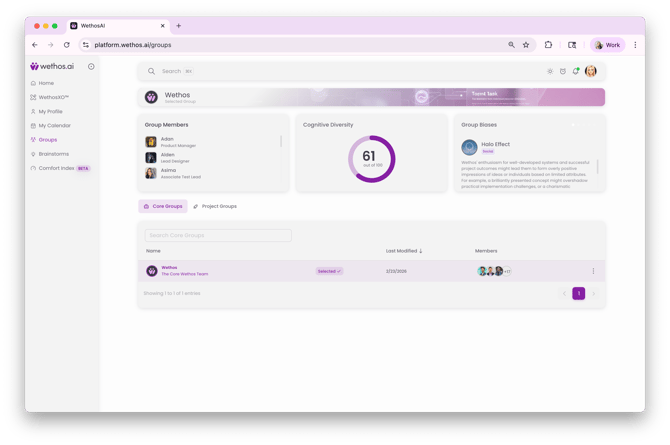
Groups are the persistent, structured backbone of collaboration in WethosAI. They reflect your organizational framework — departments, functions, or any team that operates on an ongoing basis.
Core Groups mirror your company's departmental structure. Project Groups support cross-functional collaboration around specific initiatives and can be assembled manually or through the Recommend a Group feature.
Inside a Group, you'll find an Overview with cognitive diversity scoring, a Members tab, group-level Biases, a Documents hub, WethosXO as a team coach, and Shared Conversations for ongoing team communication. Groups are where your team lives day-to-day — the home base for building relationships, understanding dynamics, and maintaining organizational cohesion.
BRAINSTORMS
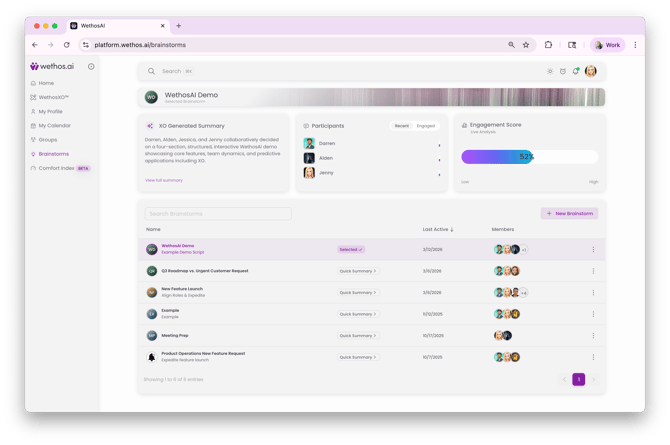
Brainstorms are outcome-driven, time-bound workspaces built for specific initiatives. While Groups provide structure and continuity, Brainstorms enable agility and focus — uniting the right people across departments to achieve defined goals.
Each Brainstorm includes a conversation area, an Artifacts panel for documents, AI-recommended Experts, live Engagement Scoring, nested Breakouts for parallel workstreams, and a Decisions Hub that automatically synthesizes outcomes with source tracking and contributor attribution. WethosXO participates as an active team member — summarizing discussions, surfacing biases, and recommending next steps based on the behavioral composition of the group.
When the initiative is complete, the workspace and its decisions persist as a searchable record.
BREAKOUTS
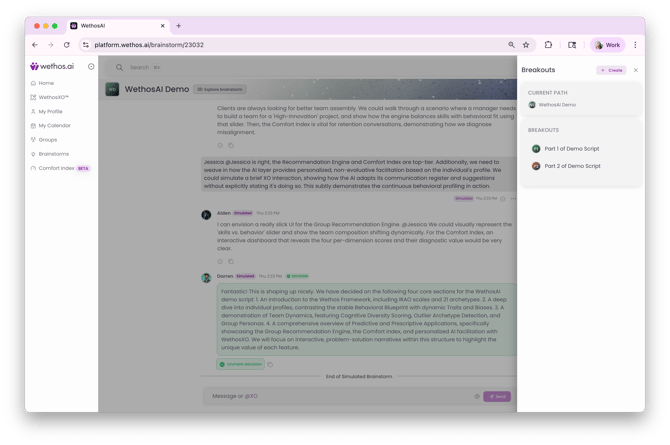
Breakouts are focused sub-workspaces nested within Brainstorms. When a tangent emerges, a sub-topic needs deeper exploration, or a specific issue requires only a subset of the team, a Breakout provides a dedicated space for that work without disrupting the main discussion thread.
Each Breakout mirrors the structure of a Brainstorm — with its own conversation area, members panel, and artifacts — but includes only the people needed for the focused discussion. A Breadcrumb Trail at the top of the screen shows the navigation path between the parent Brainstorm and the Breakout.
Multiple Breakouts can run simultaneously within the same Brainstorm, enabling parallel workstreams on different facets of the same initiative. Once a Breakout's goal is met, results can be published back into the main Brainstorm thread for broader visibility. Decisions made in Breakouts are captured in the parent Brainstorm's Decisions Hub through the "Show Descendant Decisions" feature.
SIMULATED BRAINSTORMS
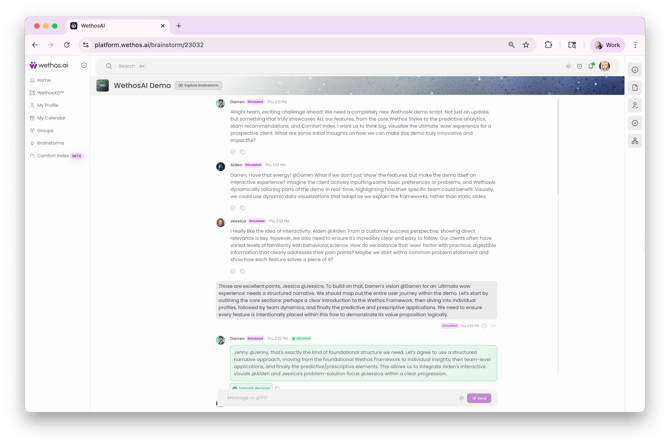
Simulated Brainstorms add an AI-driven deliberation layer before your human team gets involved. AI personas — informed by the Wethos Styles of the real team members you add — simulate a complex discussion, debating diverse viewpoints, weighing tradeoffs, and exploring risks rather than converging immediately.
The simulation produces justified decisions — outcomes where you can trace the reasoning path from disagreement to conclusion. Once the simulation completes, it automatically converts into a regular Brainstorm. Your human team can then jump in, review the logged decisions, query the retained Artifacts through XO, and take over the workflow from an informed starting point.
Simulated Brainstorms are especially valuable for exploring strategic options before a leadership decision, preparing for high-stakes meetings by anticipating objections, testing a proposed plan against diverse behavioral perspectives, and accelerating early-stage brainstorming with a rich starting discussion.
HOW THEY WORK TOGETHER
The three environments are designed to complement each other:
Groups → Brainstorms → Breakouts: A Group identifies a challenge. A Brainstorm is created to tackle it with focused, cross-functional effort. Breakouts spin up for sub-topics that need deeper exploration. Results from Breakouts publish back to the Brainstorm, and outcomes feed back into the Group's context.
Simulated Brainstorms → Brainstorms → Breakouts: A Simulated Brainstorm explores the problem space first, with AI personas debating approaches and surfacing blind spots. The simulation transitions into a regular Brainstorm where the human team picks up from an informed starting point. Breakouts are created as needed for focused sub-discussions. Decisions flow up from Breakouts to the Brainstorm's Decisions Hub.
Groups → Simulated Brainstorms → Brainstorms → Breakouts: A Group surfaces a strategic question. A Simulated Brainstorm runs the initial exploration with AI personas grounded in the team's actual Wethos Styles. The simulation converts into a Brainstorm where the real team refines the decisions and executes, spinning up Breakouts for parallel workstreams as needed. Outcomes flow back to the Group for ongoing reference.
BEST PRACTICES
For Groups
Review your Cognitive Diversity Score to ensure balanced perspectives and be mindful of groupthink or potential friction points. Use behavioral insights to improve communication and reduce conflict. Invite WethosXO when facing team dynamics challenges. Have private conversations with XO to receive personal coaching based on the Group context. Maintain open channels for ongoing communication through Shared Conversations.
For Brainstorms
Start with a clear, specific goal or outcome. Bring in diverse perspectives, even if it means crossing departmental lines. Leverage WethosXO strategically for decision support and insights. Mark decisions as they happen so outcomes aren't buried in conversation threads. Celebrate achievements and close the Brainstorm when goals are met.
For Breakouts
Create a Breakout as soon as a sub-topic emerges that needs focused attention — don't wait for the main thread to get cluttered. Include only the people needed for the discussion to keep it tight and efficient. Publish results back to the parent Brainstorm so the broader team has visibility. Use XO within Breakouts for synthesis, bias detection, and summaries that can feed back to the main workspace.
For Simulated Brainstorms
Invest time in the setup — clear goals, specific descriptions, and relevant Artifacts produce richer simulations. Choose members thoughtfully, since AI personas are based on their Wethos Styles. Review each justified decision before transitioning to human work. Use the simulation as a preparation tool, not a replacement for human judgment.
GETTING HELP
For more information or support, email wethos@wethos.ai, visit wethos.ai, or connect on LinkedIn at WethosAI.