![wethos_icon_light-mode-nmcocwgai7dk3bq6c54sa7ubcw.svg]](https://24346244.fs1.hubspotusercontent-na1.net/hubfs/24346244/wethos_icon_light-mode-nmcocwgai7dk3bq6c54sa7ubcw.svg)
THE SHORT VERSION
Your Wethos Style is your default — the way you naturally show up when nothing is pulling you in a different direction.
Traits & Biases capture what happens when something does.
The demands of your role, the people you're working with, the pressure of a deadline — all of these cause you to flex beyond your default. Traits & Biases make that flex visible.
WHAT IS YOUR WETHOS STYLE?
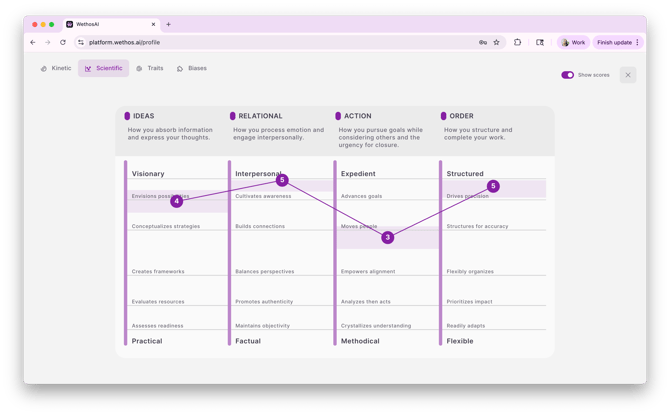
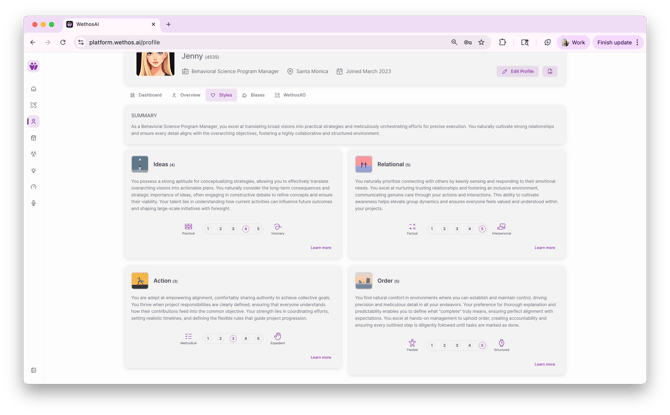
Your Wethos Style is your behavioral blueprint. It's established through the assessment and maps how you naturally approach four areas of group performance: Ideas, Relational, Action, and Order.
It describes process, not ability. Your Wethos Style doesn't say whether you're creative, empathetic, decisive, or organized. It describes how you go about ideating, relating, acting, and structuring — your instinctive approach when you're free to operate on your own terms.
Your Wethos Style is stable. It represents your foundational preferences and doesn't shift dramatically over time. It's the baseline that everything else is measured against.
WHAT ARE TRAITS & BIASES?
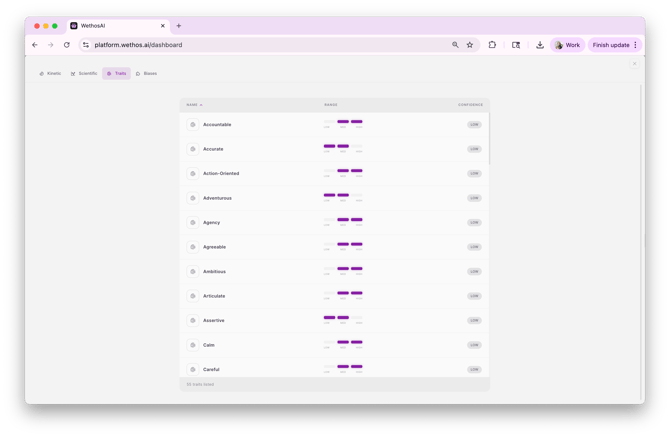
Traits are observable behavioral characteristics — what you actually do in practice. WethosAI tracks 86+ traits across categories like how you think, how you respond, your emotional patterns, your core principles, what energizes you, and how you interact with others.
Biases are cognitive patterns — how you process information and make decisions. WethosAI tracks 125+ biases across categories such as decision-making, social perception, memory, information processing, and conclusion drawing.
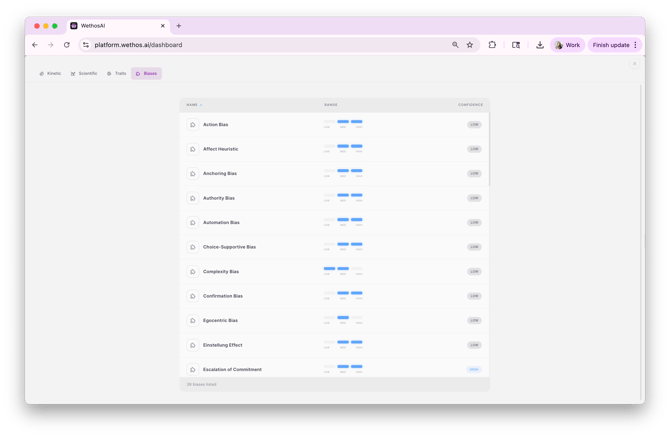
Both are measured by degree, not in absolutes. Every person possesses every trait and is susceptible to every bias. What varies is the extent to which they show up, and the context in which they emerge.
Unlike your Wethos Style, Traits & Biases are dynamic. They're enriched over time as the platform observes you in real interactions — meeting transcripts, brainstorms, and conversations on the platform. They capture how you're actually showing up, not how you answered a set of questions.
HOW THEY RELATE: BLUEPRINT AND FLEX
Your Wethos Style is your default. Traits & Biases capture where you flex beyond that default.
Nobody operates on default all the time. Your environment, your team, the stakes of a project — all of these pull you away from your natural center. That's not a problem. That's adaptability.
Consider someone who scores as an Order 5 on the Wethos Style — precision-driven, detail-oriented, process-focused by default. If they work at a fast-moving startup where things change weekly, they can't always operate at full Order 5. They adapt. Over time, "Adaptable" might show up as a strong trait in their profile. That's not a contradiction of their style — it's their style meeting reality. Their blueprint hasn't changed. Their expression of it has.
Or consider someone with a Relational 1 — factual, objective, not naturally attuned to emotional dynamics. In a management role that requires supporting people through a difficult transition, they might flex toward empathy and emotional awareness. The Traits & Biases layer would capture that flex, showing where they're stretching beyond their default style.
NEITHER IS RIGHT OR WRONG
This is a foundational principle of both frameworks.
There is no better or worse Wethos Style. An Ideas 1 is not less valuable than an Ideas 5 — they approach ideation differently, and both are needed. An Action 2 is not slower than an Action 5 — they move decisively once their analysis is complete, and that thoroughness has its own value.
The same applies to Traits & Biases. A high-confidence bias isn't a flaw to fix — it's a pattern to be aware of. Everyone is susceptible to every cognitive bias. Knowing when yours tend to surface gives you the choice to lean into them or adjust. A trait that shows up with a wide range isn't inconsistency — it's versatility. It means you show up differently in different contexts, which is often exactly what the situation requires.
Nothing in either framework is designed to label, limit, or judge. It's designed to create awareness — of your defaults, of where you flex, and of when to be intentional about which mode you're operating in.
WHY BOTH MATTER
Your Wethos Style alone tells you how you're wired. That's valuable, but it's incomplete — it doesn't account for how your environment shapes your behavior day to day.
Traits & Biases alone tell you what you're doing in practice. That's valuable too, but without the blueprint, there's no baseline to measure the flex against. You wouldn't know whether a behavior is your default or an adaptation.
Together, they give you the full picture: your foundation and your flexibility. Your instincts and your adaptations. The way you're built and the way you're growing.
That's what makes this a development tool, not just a profile. You can track how your flex evolves over time. You can see whether you're stretching into new territory or settling deeper into familiar patterns. You can make intentional choices about when your default serves you and when the moment calls for something different.
HOW THEY'RE BUILT
| Wethos Style | Traits & Biases | |
|---|---|---|
| Source | Assessment (84 questions, 8 questions, or LinkedIn) | Meeting transcripts, assessment questions, third-party assessments |
| Nature | Stable foundation | Dynamic, continuously enriched |
| What it measures | How you approach work (process) | How you show up in practice (behavior and cognition) |
| Stability | Yes — your blueprint is consistent | No — new traits and biases populate, range changes, confidence increases |
| Scope | 4 scales, 5 segments each | 86+ traits, 125+ biases |
| Philosophy | No style is better or worse | No trait is good or bad, no bias is a flaw |
IN PRACTICE
When XO coaches you before a meeting, it's using both. Your Wethos Style tells XO how you naturally communicate. Your Traits & Biases tell XO how you've been flexing lately and where your cognitive patterns might help or trip you up in this specific situation.
When XO simulates a colleague in a brainstorm, it's using both. Their Wethos Style shapes the foundation of how they'd respond. Their Traits & Biases add the nuance of how they've been showing up recently and what patterns are most active.
The two layers are always working together. You don't choose one over the other. They're complementary — blueprint and expression, foundation and flexibility, the constant and the variable.