![wethos_icon_light-mode-nmcocwgai7dk3bq6c54sa7ubcw.svg]](https://24346244.fs1.hubspotusercontent-na1.net/hubfs/24346244/wethos_icon_light-mode-nmcocwgai7dk3bq6c54sa7ubcw.svg)
OVERVIEW
One of CalendarIQ's most powerful features is pre-meeting behavioral insights — personalized coaching from WethosXO before your meetings based on the Wethos Styles of confirmed attendees. Instead of walking into a meeting cold, you get specific guidance on how to communicate, present ideas, and navigate dynamics with the actual people in the room.
These insights go beyond generic meeting prep tips. Because XO has access to each attendee's behavioral profile, the guidance is tailored to the specific combination of styles in that meeting — not just individual preferences, but how those preferences interact.
HOW IT WORKS
When you open CalendarIQ, your upcoming meetings are displayed with the attendees listed for each event. XO analyzes the Wethos Styles of confirmed participants and generates short behavioral notes designed to help you adjust your approach before the meeting starts.
These insights appear in your profile's Upcoming Meetings section and within CalendarIQ's Dashboard and Schedule views. You can also ask XO directly for deeper preparation by referencing a specific meeting or attendee.
WHAT THE INSIGHTS LOOK LIKE
Pre-meeting insights are brief, actionable coaching notes tied to specific attendees or group dynamics. They address how to frame your communication, what to expect from others, and where to watch for potential friction. For example:
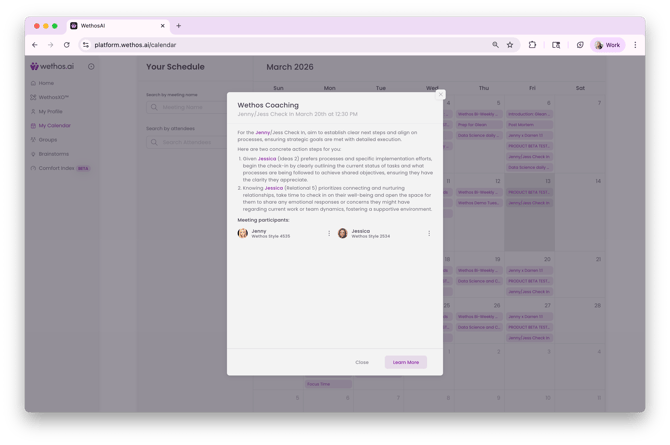
For a colleague with Order (4–5): XO might suggest sending a structured agenda in advance, sticking to the planned topics, and coming prepared with specific data points. People with high Order scores value thoroughness and predictability — surprises or loose agendas can create discomfort.
For a colleague with Ideas (4–5): XO might recommend building in open-ended exploration time, asking "what if" questions, and avoiding shutting down ideas too quickly. Visionary thinkers need space to think expansively before narrowing down.
For a colleague with Relational (4–5): XO might advise checking in on how people are feeling before diving into the agenda, acknowledging contributions personally, and leaving time for relationship-building. Interpersonally-oriented team members engage more deeply when they feel seen.
For a colleague with Relational (1–2): XO might suggest leading with facts and outcomes rather than emotional framing, being direct and concise, and focusing on the logic behind decisions. Factually-oriented team members respond best to clear, evidence-based communication.
For a colleague with Action (4–5): XO might recommend keeping the meeting moving, focusing on decisions and next steps, and avoiding extended deliberation without clear progress. Expedient styles get frustrated when discussions feel circular.
For a colleague with Action (1–2): XO might suggest allowing time for thorough analysis before pushing for a decision, presenting the full picture before asking for commitment, and not rushing closure. Methodical styles need to feel confident in the reasoning before they're ready to move forward.
GROUP DYNAMIC INSIGHTS
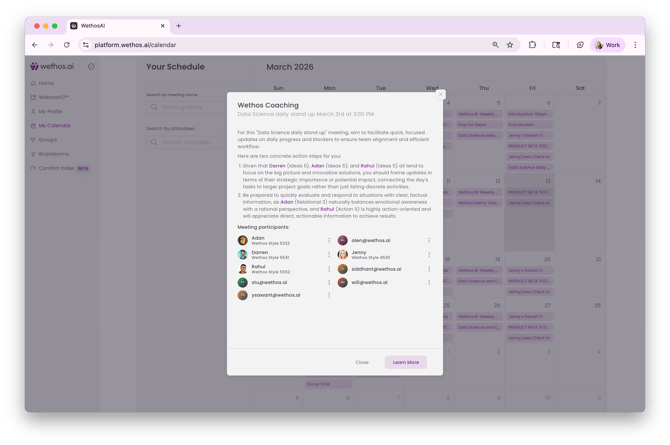
When a meeting has multiple attendees, XO doesn't just provide individual tips — it reads the room as a whole. If a meeting includes a mix of high-Order and high-Ideas participants, XO might flag that the structured thinkers may want to lock down specifics while the visionary thinkers want to keep exploring. It can suggest facilitation strategies that honor both needs, such as dedicating the first half to open brainstorming and the second half to narrowing and committing.
If most attendees cluster on the same scale, XO may flag a potential blind spot. A room full of high-Action styles might rush to decisions without enough analysis. A room full of high-Relational styles might prioritize harmony and avoid necessary conflict. These group-level insights help you plan how to facilitate, not just participate.
HOW TO GET DEEPER PREP
The default pre-meeting insights are brief coaching notes. If you want more detailed preparation, you can continue the conversation with XO and ask follow-up questions. XO retains the context of your meeting and attendees, so you can go as deep as you need without re-explaining who's involved.
You can also ask XO to generate or tailor your meeting agenda based on the attendees' behavioral profiles. Rather than writing a one-size-fits-all agenda, XO can structure the flow, timing, and discussion format to match how the specific people in the room process information, make decisions, and engage. For example, XO might front-load open exploration for a group with high-Ideas participants, build in structured decision checkpoints for high-Order attendees, or suggest a round-robin format to ensure high-Relational members feel heard.
Some effective prompts include:
- "Help me prepare for my 2pm meeting with @Sarah and @John. What should I keep in mind about their styles?"
- "Can you write an agenda for this meeting that's tailored to the attendees' behavioral profiles?"
- "I need to present a budget cut to a group that includes three high-Relational team members. How should I frame the message?"
- "My next meeting has @David (Order 5) and @Lisa (Ideas 5) — they tend to clash. How can I facilitate effectively?"
- "I'm giving feedback to @Mark in our 1:1 tomorrow. Based on his style, what approach would land best?"
- "I have a brainstorming session with my team this afternoon. Based on everyone's styles, how should I structure it so all voices are heard?"
- "Adjust this agenda to better fit the communication preferences of the people attending."
Because XO has access to attendees' Wethos Styles and retains the conversation context, you can start with a general prep question, then drill into specific attendees, ask for an agenda, refine the format, and keep going until you feel fully prepared.
USING INSIGHTS FOR DIFFERENT MEETING TYPES
One-on-Ones
Pre-meeting insights are especially valuable for 1:1s where the relationship dynamic matters most. XO can help you understand how your style interacts with the other person's — where you naturally align and where friction might arise. If you're a high-Action manager meeting with a high-Order direct report, XO might remind you to slow down and give them space to walk through details rather than jumping straight to decisions.
Team Meetings
For recurring team meetings, pre-meeting insights help you rotate your facilitation approach based on who's attending. If a key contributor is absent one week, the group dynamic shifts — XO can flag how the remaining composition changes the likely flow of conversation.
Cross-Functional Meetings
When meeting with people from other departments who you don't work with daily, pre-meeting insights fill the gap. You may not know their communication preferences intuitively, but XO does. A quick review before the meeting can prevent miscommunication and help you build credibility faster.
High-Stakes Meetings
Before presentations to leadership, client meetings, or difficult conversations, XO's prep becomes a strategic advantage. Understanding how decision-makers process information — whether they want the executive summary first or the full analysis, whether they respond to data or narrative — can meaningfully change how your message lands.
For especially high-stakes meetings, consider running a Simulated Brainstorm as part of your preparation. Add the meeting attendees, inject the agenda and any supporting documents as Artifacts, and let AI personas — informed by the attendees' actual Wethos Styles — simulate the conversation before it happens. You can watch how different behavioral perspectives might react to your proposal, identify objections you hadn't anticipated, and refine your approach based on the tradeoffs the simulation surfaces. When the simulation completes, review the justified decisions and use them to inform your strategy going into the real meeting.
BUILDING A PRE-MEETING HABIT
The most effective way to use pre-meeting insights is to make them part of your routine. Check CalendarIQ at the start of each day and review the behavioral notes for your upcoming meetings. For high-stakes meetings, ask XO for a deeper preparation session the day before. Over time, you'll develop a natural fluency for reading the room before you walk into it.
With Persistent Conversations, you can maintain ongoing prep threads for recurring meetings or key relationships. Return to previous coaching sessions without re-explaining the context, and build on XO's prior advice as the relationship or project evolves.
TIPS
Review insights even for people you know well. Familiarity can create blind spots — you may have adapted to a colleague's style unconsciously but still benefit from a reminder about where your defaults might create friction.
Pay attention to group composition, not just individuals. A meeting where three of four attendees are high-Order will feel very different from one where the same group includes a high-Ideas wildcard. XO's group-level insights help you anticipate these dynamics.
Use insights to adjust your approach, not to label people. The goal is awareness and adaptation, not categorization. Every person is more than their Wethos Style — the insights are a starting point for more effective communication, not a script.
Ask XO for follow-up after the meeting too. Post-meeting reflection ("How did that meeting go given the styles in the room? What could I do differently next time?") closes the loop and deepens your behavioral awareness over time.