![wethos_icon_light-mode-nmcocwgai7dk3bq6c54sa7ubcw.svg]](https://24346244.fs1.hubspotusercontent-na1.net/hubfs/24346244/wethos_icon_light-mode-nmcocwgai7dk3bq6c54sa7ubcw.svg)
WHAT IT'S FOR
Your traits and biases are the foundation of your Wethos experience. Every time XO coaches you in a roleplay, analyzes group dynamics for a meeting, or simulates a colleague's perspective in a decision — it's pulling from this behavioral data. The Traits & Biases view gives you direct access to your profile so you can understand what the system sees, how confident it is, and how your patterns are evolving over time.
HOW TO ACCESS IT
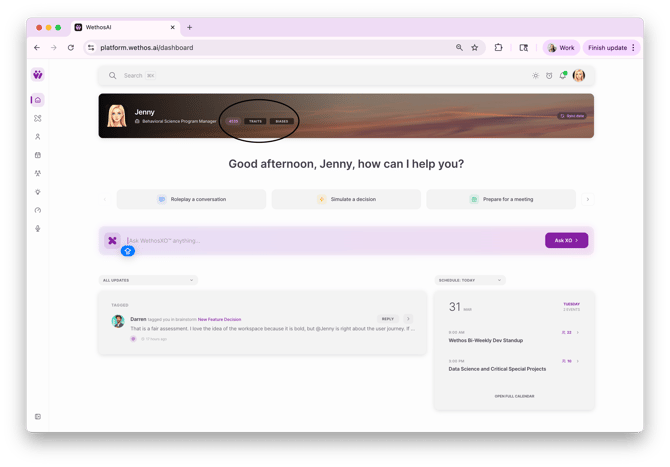
You can get to your Traits & Biases from two places: clicking the "TRAITS" or "BIASES" badges on your profile banner at the top of the dashboard, or navigating through your profile in the sidebar.
THE FOUR TABS
Kinetic
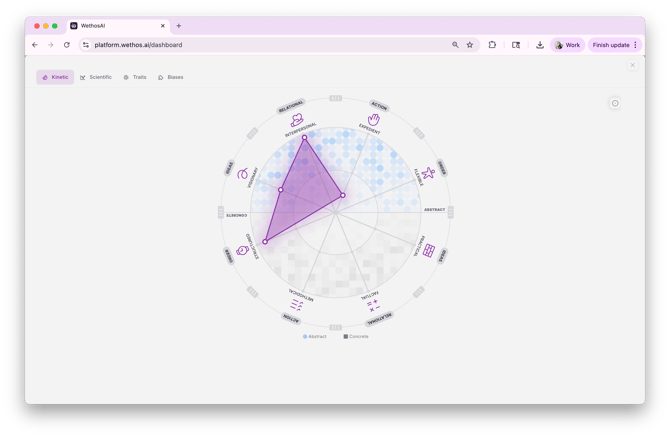
A dynamic visualization of your Wethos Style — your behavioral blueprint. This is the foundation that the traits and biases framework is built on top of. Kinetic shows how your style moves and interacts in a visual format.
Scientific
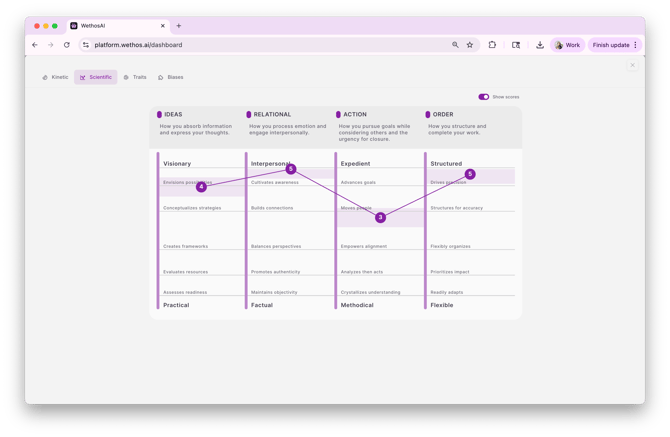
A detailed, research-backed view of your Wethos Style. While Kinetic gives you the visual picture, Scientific breaks down the underlying dimensions and frameworks that define your behavioral blueprint.
Traits
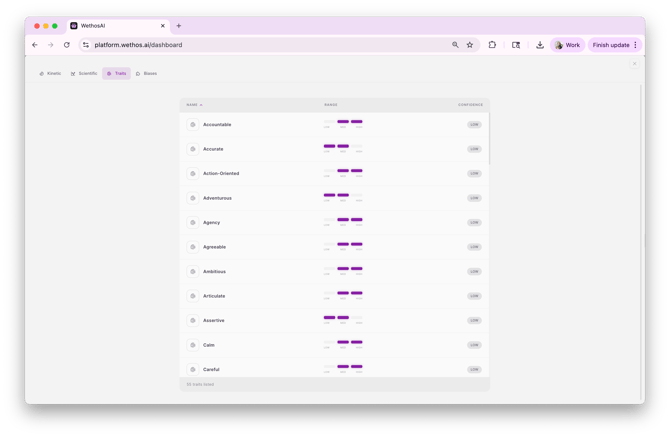
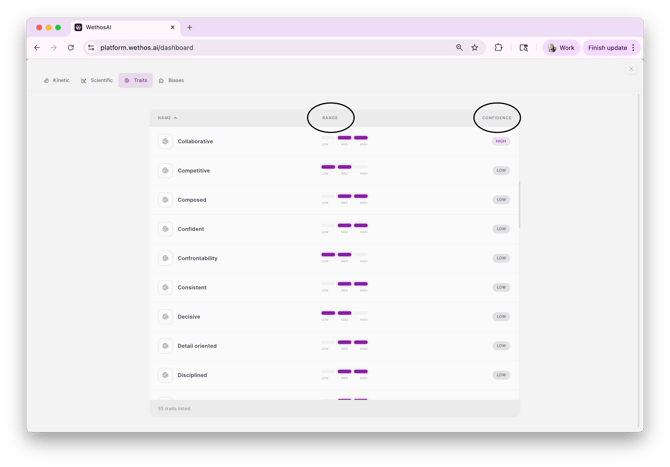
Your full list of identified traits. The platform currently tracks 86+ traits, and that list is always growing as we expand the behavioral engine. Each trait is displayed with:
- Name — The trait itself (e.g. Accountable, Accurate, Action-Oriented, Adventurous, Agency, Agreeable)
- Range — A visual bar showing where the trait tends to show up across Low, Med, and High. Some traits have a narrow range, meaning they show up consistently. Others have a wide range, meaning they're more context-dependent — you might be highly action-oriented in 1:1 settings but more reserved in large group meetings.
- Confidence — How much evidence the system has gathered to support this assessment. Confidence starts at Low and increases as you use the platform — participating in brainstorms, roleplays, groups, and conversations all contribute. A Low confidence trait isn't unreliable, it just means the system needs more data to be sure.
Biases
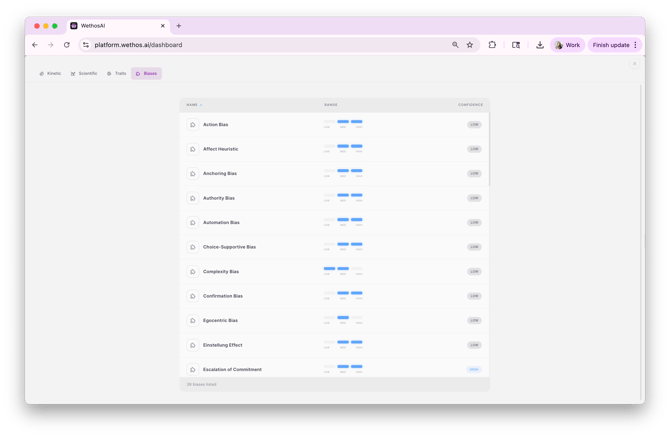
Your full list of identified cognitive biases. The platform currently tracks 125+ biases, and this list continues to expand. The format is the same as traits — each bias has a name, range, and confidence level.
Biases include things like Action Bias, Affect Heuristic, Anchoring Bias, Authority Bias, Automation Bias, and Choice-Supportive Bias, among many others. These aren't labels or judgments — they're patterns that everyone has. Understanding yours helps you make better decisions and communicate more effectively.
HOW RANGE AND CONFIDENCE WORK TOGETHER
The range tells you where a trait or bias shows up. The confidence tells you how sure the system is about that range.
A trait with a narrow range and high confidence means the system has strong evidence that you consistently show up that way. A trait with a wide range and low confidence means the system has seen some signals but doesn't yet have enough data to pin it down — it could be context-dependent, or it could sharpen as more evidence comes in.
As you use the platform more, two things happen: new traits and biases will continue to populate on your profile as the system identifies new patterns, and the confidence on existing ones will increase as more evidence accumulates. Early on, you may see mostly Low confidence across the board. That's normal — it means the system is still learning. Over time, those levels climb and your profile becomes a richer, more accurate picture of how you show up.
ASKING XO TO ANALYZE YOUR PATTERNS
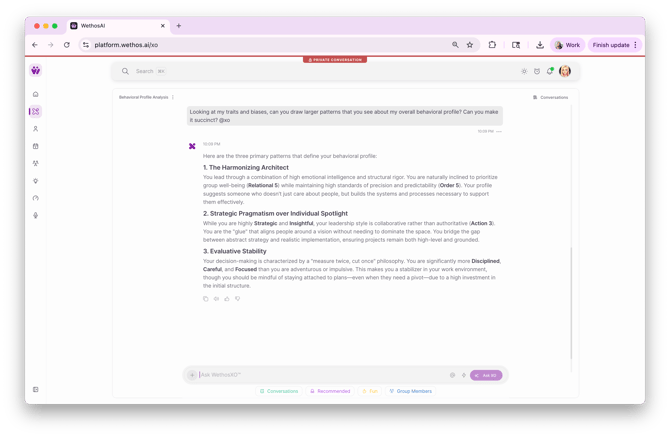
From any conversation on the platform, you can ask XO to dig into your traits and biases. For example:
- "@XO using my traits and biases, can you point out patterns and trends about my behavioral style and how I show up at work?"
- "@XO when does my Anchoring Bias show up most?"
- "@XO which of my traits are most context-dependent?"
- "@XO how do my traits compare to [colleague's] and where might we clash?"
XO pulls from your Traits & Biases profile to give you answers grounded in your actual behavioral data — not generic personality advice.
TRACKING GROWTH OVER TIME
This is where Traits & Biases becomes more than a profile — it becomes a development tool. When you come back over time, you can see how your confidence levels and ranges change. Maybe after a quarter of intentionally practicing faster decision-making, your Decisiveness confidence moves from Low to Med. Maybe your Action Bias range tightens as the system sees more consistent evidence.
That's measurable behavioral growth — not just a one-time assessment, but a living profile that reflects how you're evolving.
PRIVACY
This view of your Traits & Biases is private to you but other users can specifically ask XO for a list of your traits and biases and XO will deliver that list in a table format.