![wethos_icon_light-mode-nmcocwgai7dk3bq6c54sa7ubcw.svg]](https://24346244.fs1.hubspotusercontent-na1.net/hubfs/24346244/wethos_icon_light-mode-nmcocwgai7dk3bq6c54sa7ubcw.svg)
OVERVIEW
WethosAI is built on a behavioral assessment developed over 30 years of empirical research focused specifically on team performance. Unlike most behavioral tools created in the 1980s, which were designed to describe individual personality characteristics, WethosAI was built to be predictive — identifying how people naturally behave in group settings and how those behaviors influence the people around them.
The goal was to create an assessment with exceptional internal consistency that would help individuals and groups perform at a higher level by recognizing their default behaviors and gaining awareness of how those behaviors shape collaboration, communication, and decision-making.
THE RESEARCH FOUNDATION
The empirical research behind WethosAI identified four highly consistent activities that impact group performance. These four activities became the foundation for the platform's four behavioral scales: Ideas, Relational, Action, and Order.
Based on this research, the Wethos assessment analyzes 84 items that identify how people naturally behave within these four areas of group performance. The assessment produces actionable, objective feedback — not abstract personality labels, but specific behavioral patterns that directly affect how you work with others.
VALIDITY AND RELIABILITY
The results demonstrate an excellent internal consistency of reliability with a high degree of construct validity. Three independent statistical methods support this conclusion:
Exploratory Factor Analyses (EFA) — Confirmed that the assessment items cluster into the four distinct behavioral factors (Ideas, Relational, Action, Order) as theorized, with strong factor loadings and minimal cross-loading between scales.
Multi-Trait Multi-Method (MTMM) Matrix — Validated that the four scales measure genuinely distinct constructs while confirming convergent validity within each scale. This ensures that the assessment is measuring four separate behavioral dimensions rather than variations of the same underlying trait.
Confirmatory Factor Analyses (CFA) — Verified the four-factor model against the data, confirming that the theoretical structure holds up under rigorous statistical testing.
All three methods strongly support the conclusion that the Wethos assessment demonstrates excellent validity — meaning it measures what it claims to measure, and it does so consistently.
THE CORE PHILOSOPHY: SITUATIONAL CONTINGENCY THEORY
WethosAI is grounded in Situational Contingency Theory, which holds that there is no single "best" behavioral style. The most effective behavior depends on the specific moment, context, and people involved. A style that drives success in one situation may create friction in another.
This philosophy shapes every aspect of the platform. WethosAI does not rank styles as better or worse. It does not suggest that certain profiles are more valuable than others. Instead, it helps individuals understand their default behaviors, recognize how those behaviors affect their teams, and develop the awareness to intentionally adapt when the situation calls for it.
This same philosophy extends to the Traits & Biases framework: every person possesses every trait to some degree, and every person is susceptible to every cognitive bias. There are no binary categories or absolutes. What matters is understanding when and how these patterns emerge, and the degree to which they influence your behavior in specific contexts.
THE FOUR SCALES
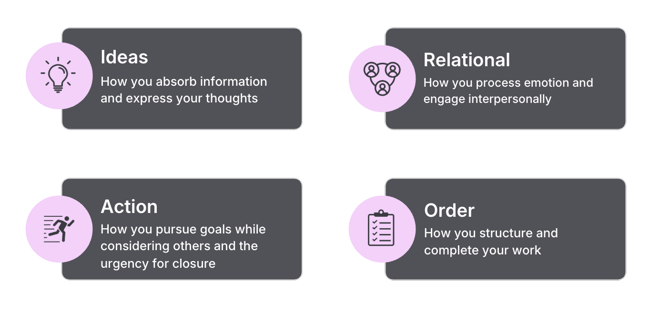
The assessment measures behavior across four scales that represent the four activities integral to team performance:
Ideas (Practical → Visionary)
Measures how you absorb information and express your thoughts. This scale captures whether you tend toward grounded, detail-oriented thinking or big-picture, possibility-driven exploration. It also reflects how you process ideas — whether by verbalizing them, asking questions, or thinking them through silently — and how quickly you move from concept to action.
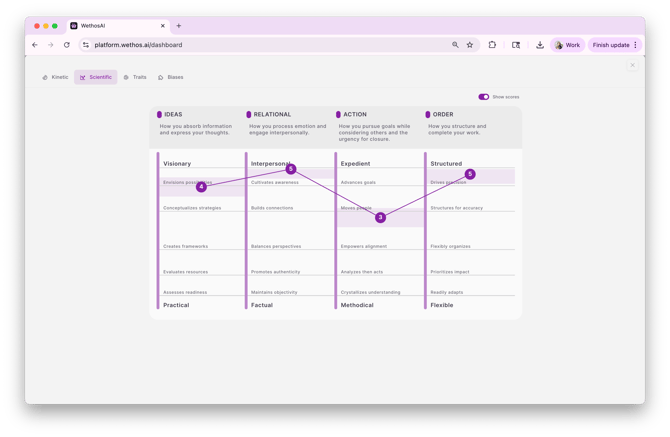
The five segments are: Assesses Readiness (1), Identifies Requirements (2), Balances Perspectives (3), Generates Possibilities (4), and Envisions Possibilities (5).
Key questions this scale answers: Are you more visionary or practical? Do you summarize ideas or describe them in detailed narratives? Do you start by asking "what else," "how to," or "with what"?
Relational (Factual → Interpersonal)
Measures how you process emotion and engage interpersonally. This scale captures how attuned you are to others' emotions, whether you tend to feel or observe those emotions, and whether you are more inclined to nurture, manage, or set aside emotional dynamics in group settings.
The five segments are: Maintains Objectivity (1), Applies Awareness (2), Facilitates Understanding (3), Personalizes Interactions (4), and Cultivates Awareness (5).
Key questions this scale answers: How apparent must others' emotions be before you notice them? Do you typically feel or observe others' emotions? Are you more inclined to nurture emotions, manage them, or rarely acknowledge them?
Action (Methodical → Expedient)
Measures how you pursue goals while considering others and your urgency for closure. This scale captures whether you focus more on the achievement of goals or the activities necessary to achieve them, and whether you tend to direct others or take on tasks yourself in recognition of others' needs.
The five segments are: Crystallizes Understanding (1), Ensures Accuracy (2), Sustains Momentum (3), Drives Progress (4), and Advances Goals (5).
Key questions this scale answers: Are you asking "is it done?", "is everything working?", or "is it working right?" Are you more inclined to direct others toward goals, or to step in and do the work yourself?
Order (Flexible → Structured)
Measures how you structure and complete your work. This scale captures whether you prefer orderly routines and processes or a more creative, flexible approach, whether you are hands-on or hands-off when managing performance, and how complete a project needs to be before you're ready to move on.
The five segments are: Readily Adapting (1), Streamlines Priorities (2), Balances Structure (3), Systematizes Workflows (4), and Drives Precision (5).
Key questions this scale answers: Do you like following processes or taking a flexible approach? Are you more hands-on or hands-off? How finished does something need to be before you move on?
HOW RESULTS WORK
A Range, Not a Fixed Point
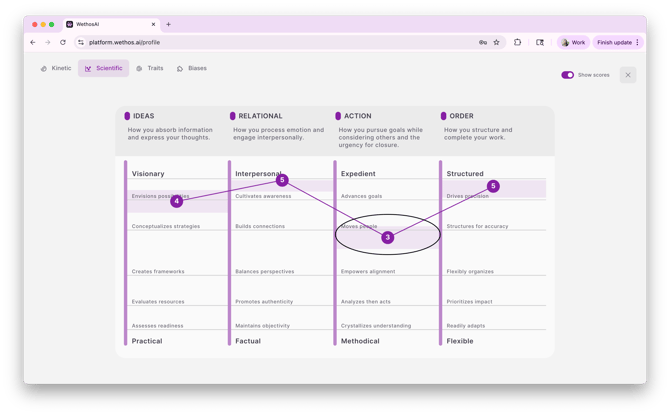
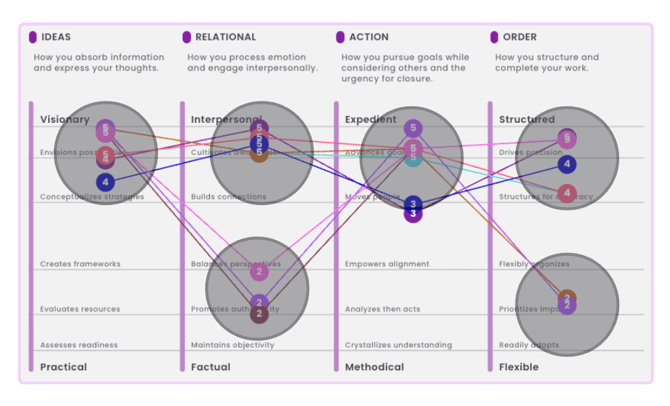
Your results are not a single static number on each scale. They identify a default range of movement — a 15% band within which your behavior naturally fluctuates depending on context, stress, and situation. This range is represented by shaded areas on your Wethos Style Scientific Graph.
Behavioral Categories
Each of your four scale results falls into one of three behavioral categories:
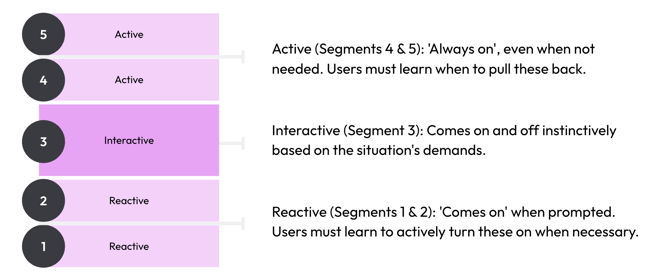
Active (4–5) — Always on. These are your default behaviors, consistently present in your interactions regardless of context.
Interactive (3) — Instinctive when needed. These behaviors emerge naturally when the situation calls for them but aren't always front and center.
Reactive (1–2) — Triggered by specific prompts. These behaviors require intentional effort or a particular situation to surface. They are part of your repertoire but not where you naturally operate.
Behavioral Flexing
While your default range of movement is approximately 15%, WethosAI coaches you to intentionally "flex" beyond your default range when the situation requires it. For example, someone who naturally is a 2 on the Ideas scale (practical, detail-focused) can learn to flex toward more visionary thinking when a brainstorm calls for it — and the platform provides the coaching to make that flex intentional and effective.
This is not about changing who you are. It is about expanding your awareness of when a different approach would serve you and your team better, and developing the skill to move into that space deliberately.
Interpreting the Movement Between Scales
The four scales are not independent dimensions — they are interconnected facets of a behavioral profile. The movement of the line connecting your four scale results reveals the complexity of how you transition from thought to execution.
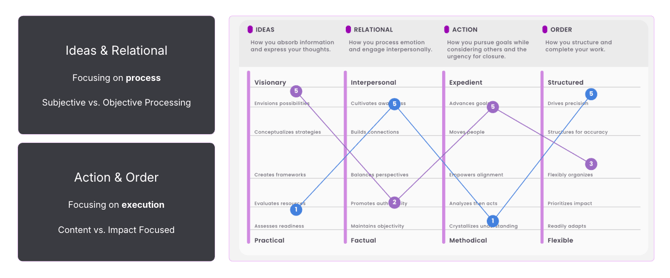
Decision-Making Flow (Ideas → Relational) — The movement from your Ideas result to your Relational result shows how you move from initial thought to choice. A steep drop from a high Ideas result to a low Relational result suggests you process decisions objectively — through logic and analysis. A line that stays high across both scales suggests you process decisions subjectively — seeking consensus, emotional alignment, and relational buy-in before committing.
Execution Flow (Action → Order) — The movement from your Action result to your Order result reveals how you move from task to completion. A high Action result paired with a lower Order result suggests you prioritize impact and velocity — getting things done quickly even if they're not perfectly polished. A lower Action result paired with a high Order result suggests you prioritize content and precision — taking more time to ensure thoroughness and quality.
Peaks and Clusters
Peaks identify which scales dominate an individual's profile — the behaviors that are most consistently active and visible.
Clusters emerge at the group level, revealing where a team's behavioral energy concentrates. Clusters show team alignment and shared energy, but they also surface potential blind spots — areas where the group may lack representation and where important perspectives might be missed.
360-Degree Integration
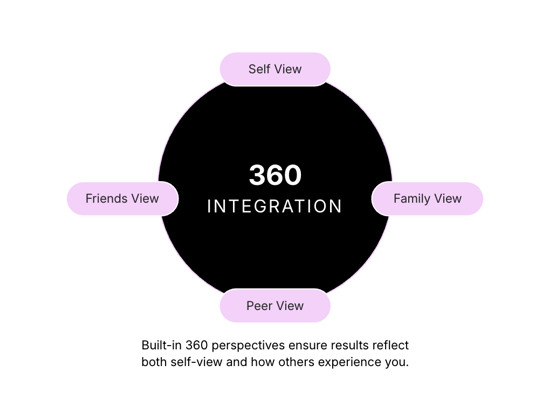
WethosAI's assessment incorporates multiple perspectives to ensure results reflect a complete behavioral picture. Built-in mechanisms capture both your self-view and how others — peers, collaborators, and leadership — experience your behaviors. This multi-perspective approach reduces blind spots and produces a more accurate, well-rounded profile than self-assessment alone.
THE PROPRIETARY TAXONOMY
Beyond the four Wethos Style scales, the platform operates on a deeper taxonomy that enriches profiles over time through real interaction data.
Traits
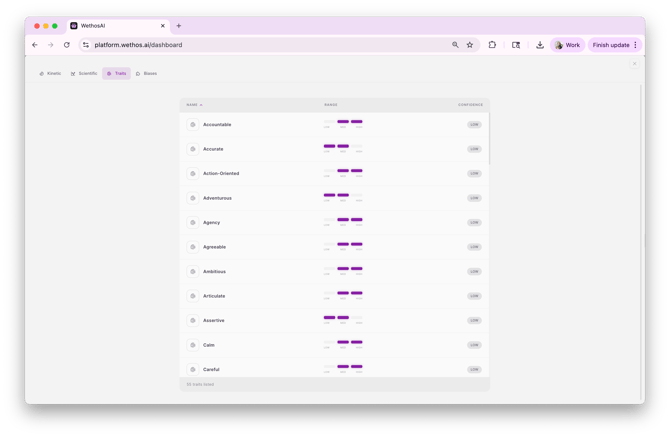
Observable behavioral characteristics measured by degree across 86+ dimensions. Unlike the four scales (which are established through the assessment), traits are enriched dynamically as the platform analyzes meeting transcripts and platform interactions.
Traits are organized into six categories:
Wisdom — How you think and process information. Sub-categories include mental processing, knowledge and learning, decision making, and innovation/creativity.
Expression — How you act and respond to situations. Sub-categories include adaptability, risk tolerance, initiative, organization and planning, and response style.
Temperament — Your emotional nature and patterns. Sub-categories include emotional control, emotional range, and emotional disposition.
Heart — Core principles and moral foundation. Sub-categories include integrity, responsibility, ethics, and service orientation.
Outlook — What moves and energizes you. Sub-categories include ambition and goal focus.
Sociability — How you relate to and interact with others. Sub-categories include social connection, communication, and influence.
Traits are identified through communication patterns in meetings, language choices and expression styles, interaction dynamics with team members, response patterns to different situations, and consistency of behaviors across multiple observations.
Cognitive Biases
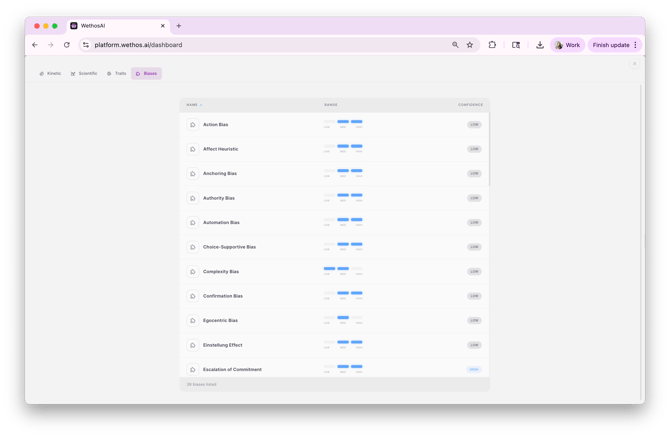
Cognitive shortcuts and thinking patterns that influence decision-making and communication, tracked across 125+ dimensions. Every person is susceptible to every cognitive bias — the platform measures tendency, not possession. What varies between people is the degree to which certain biases influence their thinking in specific contexts.
Biases are organized into six categories:
Decision Making — Systematic errors that distort how you evaluate options and make choices. Sub-categories include choice and preference formation, risk assessment, and value attribution.
Behavioral — Patterns of action that deviate from rational behavior. Sub-categories include action vs. inaction tendencies and planning distortions.
Social — Distortions in how you perceive and respond to others. Sub-categories include group perception, attribution and judgment, social comparison, interpersonal dynamics, and cultural and identity biases.
Memory & Recall — Errors in how you store and retrieve information. Sub-categories include storage distortions, retrieval errors, pattern recognition, time-related memory, and information retention.
Information Processing — Flaws in how you attend to, organize, and interpret new data. Sub-categories include attention and focus, analysis and evaluation, context effects, and mental shortcuts.
Inferential — Errors in how you draw conclusions from evidence and make predictions. Sub-categories include statistical reasoning, prediction and forecasting, and causation assessment.
The platform identifies bias patterns through transcript analysis and provides mitigation coaching through WethosXO.
HOW IT ALL FITS TOGETHER
Blueprint and Expression
WethosAI operates on two complementary layers that together provide a complete behavioral picture.
Layer 1: Your Wethos Style (The Blueprint)
Your Wethos Style is your foundational behavioral blueprint — the consistent "how" behind the way you approach work. It's established through the assessment and maps your behavior across the four scales described above. It remains stable over time and represents your fundamental working preferences.
Each scale describes how you approach a different aspect of work — not whether you possess certain qualities, but how you naturally go about things. An Order 1 isn't disorganized — they can be extremely organized when the situation calls for it. They simply prefer flexible, autonomous structures over rigid processes. An Ideas 5 isn't impractical — they ground their abstract thinking in strategic value and can drill into details when exploring innovations.
Layer 2: Traits & Biases (The Expression)
While your Wethos Style captures your consistent approach, Traits & Biases capture how you flex that approach in real situations. This layer is enriched dynamically as the platform analyzes meeting transcripts and your interactions on the platform.
Unlike one-time assessments that provide a snapshot, the Traits & Biases framework continuously analyzes real workplace interactions. Every meeting transcript adds depth to your profile. Because analysis is based on natural workplace interactions rather than test responses, there's no way to game the system or present an idealized version of yourself. The insights reflect authentic behavior.
For example, someone who has an Order result of 5 ("Drives Precision") will always prefer to follow steps meticulously. But their Traits & Biases profile might reveal how they flex toward adaptability when working in a fast-paced environment, which cognitive biases influence their attention to detail under pressure, and how they adapt their methodical approach when collaborating with teammates who thrive on flexibility. This doesn't mean that one is correct or not, Traits and Biases are looking at how you flex your style in various real-time situations.
The Complete Picture
Together, these two layers reveal your preferred approaches and natural tendencies, how those preferences flex in different situations, the full range of your capabilities when contexts demand adaptation, and the unique way you express universal human traits and navigate universal cognitive biases.
The Enrichment Pipeline
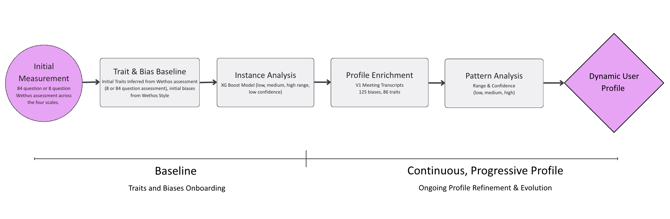
Profile depth follows a progressive path:
- Assessment — Your Wethos Style is established across the four scales.
- Initial Traits — Early behavioral traits are derived from how you answered the assessment.
- First Meeting Transcript — Behavioral observations begin from real interaction data.
- Enrichment — Your profile deepens with each additional transcript and platform interaction.
- Intelligence — The combination of foundational style, observed traits, and identified biases creates a rich, dynamic behavioral picture that reflects both your defaults and your flexibility.
ONBOARDING OPTIONS
WethosAI offers three paths to establish your Wethos Style:
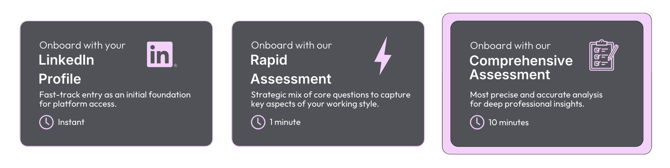
LinkedIn Profile Connection — Instant results with zero time investment. Best for getting started quickly. Initial insights are less personalized but refine over time as more data flows into the platform.
Rapid 8-Question Assessment (1 minute) — A focused set of questions that delivers meaningful insights with minimal time investment. A strong balance of speed and accuracy.
Comprehensive 84-Question Assessment (10 minutes) — The most detailed and nuanced option. Produces the highest accuracy and the richest understanding of your working style. Recommended for users who want to maximize platform value from the start.
All three paths produce a valid Wethos Style. The comprehensive assessment simply provides more data points for the platform to work with initially, resulting in a more detailed starting profile.
THIRD PARTY ASSESSMENT INTEGRATION
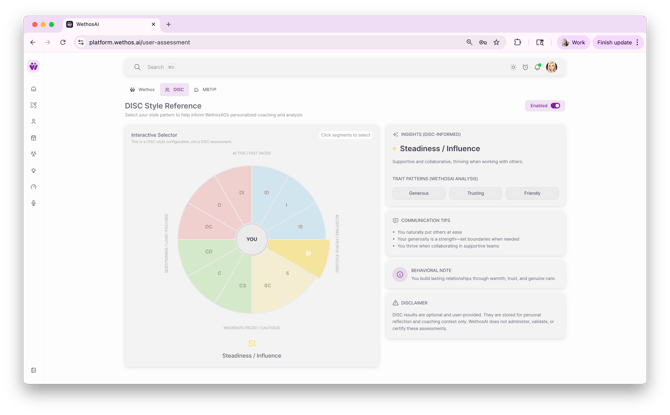
WethosAI also supports integration with existing assessment frameworks. If your team members have their MBTI or DISC results, they can self-report those in their profile settings. Once added, XO contextually knows their MBTI and DISC alongside their Wethos Style and will weave all three into its coaching and insights.
USAGE GUARDRAILS
The science behind WethosAI is designed to unlock potential — never to limit it. The platform must never be used to judge individuals, limit contributions, create hierarchies, enforce rigid role definitions, make personnel decisions, discriminate or marginalize, excuse neglect or non-participation, or undermine personal accountability.
WethosAI is a tool for building trust, creating psychological safety, and celebrating cognitive diversity. Every feature on the platform is built with this principle at its foundation.